






Asma Jan Muhammad | What Leadership Feels Like From the Inside
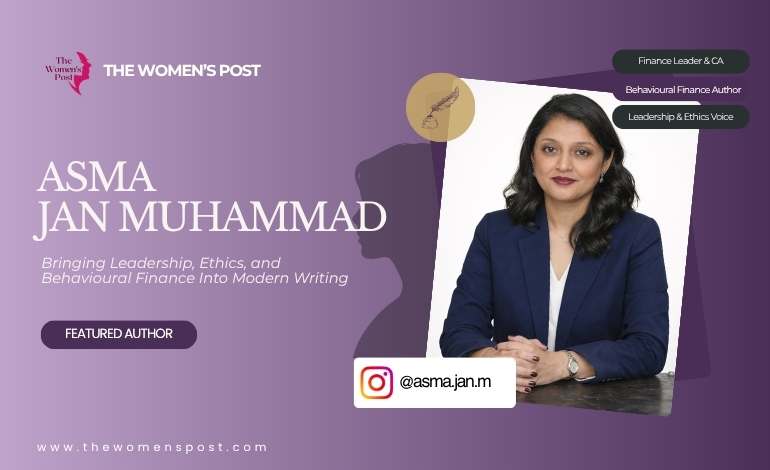

Dubai-based finance leader and UAE Emerging Author of the Year, Asma Jan Muhammad writes about ambition, ethics, and the human dimensions of decision-making. In this conversation, she reflects on Smart But Wrong, behavioural finance, and why true success depends on awareness as much as achievement.
Writing from the Realities Behind Leadership
Asma Jan Muhammad is widely recognised as a finance leader and Chartered Accountant with more than two decades of professional experience across global organisations. Alongside her corporate career, she has built a distinct voice as an author whose work explores ambition, ethics, resilience, and the human realities behind professional success.
Her books Reflections, S.H.O.R.E.: The Ultimate Descent, Maya’s Paradox, and Smart But Wrong combine storytelling with insight drawn from real corporate environments. Rather than presenting leadership as a purely strategic journey, her writing focuses on the emotional and ethical decisions that shape long-term outcomes.
What makes her perspective particularly distinctive is the intersection she occupies between finance and human behaviour. Her professional background offers insight into how leadership decisions are made at senior levels, while her writing explores the emotional and ethical dimensions that often accompany those decisions. Her work is shaped by more than two decades of leadership experience across global organisations, where she has witnessed first-hand how financial decisions intersect with human behaviour.
When Writing Became a Way to Reflect on Leadership
For Asma, writing did not begin as a planned creative pursuit but gradually emerged from moments of reflection during demanding years in professional life, when she felt that numbers could explain performance but not always experience.
Writing became a way to process complex moments involving responsibility, integrity, and consequence. These were the types of experiences that rarely find space in formal corporate conversations.
Over time, these reflections evolved into published work. What distinguishes her writing is its grounding in lived experience. The conflicts her characters face are familiar to many professionals. They include balancing growth with values, navigating uncertainty, and redefining success beyond titles or achievements.
Among her works, Maya’s Paradox stands out for its exploration of ethical tension within ambition. The book reflects a challenge many professionals encounter during their careers. How can someone pursue progress without losing personal clarity?
Across her writing, a consistent idea emerges. Achievement becomes meaningful only when it remains aligned with awareness and integrity.
From Corporate Leadership to the Author’s Desk
Asma describes herself first as a finance professional and Chartered Accountant. Writing developed later as a form of reflection shaped by her professional experiences.
Her work now explores the intersection of ambition, ethics, leadership, and human decision-making. These themes are drawn directly from situations she observed during more than twenty years in corporate roles.
Her books combine narrative storytelling with insight drawn directly from real corporate environments. Rather than focusing solely on the outcome of success, she examines the choices, dilemmas, and values that shape the journey toward it.
Her titles are available internationally through platforms such as Amazon and Barnes & Noble. Readers have responded positively through communities like Goodreads, leading to book talks and reader engagement across the UAE and Pakistan.

Her work has also been recognised with the UAE Emerging Author of the Year award, reflecting the growing reach of her ideas and writing.
Books That Explore Ambition and Ethics

Each of Asma’s books explores a different dimension of leadership and personal growth.
- Reflections encourages readers to pause and examine experiences that shape professional identity.
- S.H.O.R.E.: The Ultimate Descent explores resilience and personal journeys through uncertainty.
- Maya’s Paradox focuses on the ethical tensions that can arise when ambition meets personal values.
Her recent work, Smart But Wrong, explores another important theme. “Why do intelligent decisions sometimes fail?”
Through these books, she explores how pressure, responsibility, and human behaviour influence leadership decisions.
Across all of her work, one message remains consistent. Success becomes meaningful only when it remains connected to awareness and values.
The Human Side of Financial Decisions
One of the most distinctive themes in Asma’s writing is the connection between finance and human behaviour.
Financial decisions are often presented as purely analytical. In reality, they are shaped by many human factors. Pressure, incentives, culture, timing, and individual bias can all influence leaders’ choices.
Asma believes the separation between numbers and behaviour remains one of the most common misconceptions in modern leadership.
“Financial decisions are often presented as purely rational, yet they are deeply influenced by pressure, bias, culture, and emotion.”
Her book Smart But Wrong explores how these behavioural influences affect decision-making inside organisations. The work encourages leaders to recognise how psychological factors shape outcomes.
She also addressed this topic in a Gulf News opinion article titled Why intelligent decisions fail and what we can learn from them.
For Asma, finance is not simply about managing capital. It is about shaping consequences.
Writing as Reflection and Observation
Asma’s writing process begins with observation rather than rigid planning. Ideas often emerge from conversations, leadership dilemmas, or moments of reflection during professional life.
She captures thoughts as they appear and allows them to develop gradually into themes and narratives.
Her process prioritises clarity over speed.
“The process is less about speed and more about clarity. I prefer to write when an idea feels fully understood rather than forcing structure too early.”
This approach allows her work to remain closely connected to lived experience.
Early Challenges of Becoming an Author
Transitioning from private writing to public publishing presented its own challenges.
Publishing required openness that initially felt unfamiliar for someone trained in the structured communication of corporate environments.
There were also practical learning curves around publishing platforms, readership development, and visibility.
Yet the most significant challenge was internal. It required confidence to share personal reflections and experiences publicly.
Over time this confidence allowed her writing to reach readers who recognised similar experiences within their own professional lives.
Her Writing Blueprint
Behind every author’s work lies a system of habits that supports creativity and reflection.

Notes App
Capturing ideas in real time when insights appear.
Quiet early mornings or late evenings
Providing uninterrupted space for thinking and writing.
Professional experiences
Serving as the most authentic source of inspiration.
Reading across finance, psychology, and leadership
Helping shape a deeper perspective.
These habits allow observations from daily life to evolve into thoughtful stories.
Ethical Leadership in Modern Organisations
Ethical leadership remains a central theme in Asma’s thinking.
In many organisations, ethics is often discussed through governance structures and compliance frameworks. While these systems are important, she believes ethical leadership extends beyond formal rules.
Ethical leadership reflects consistency between intent, decision, and impact.
In modern organisations leaders often face complex situations where the right path is not immediately clear.
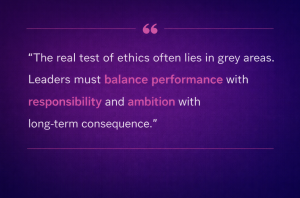
Maintaining that balance requires awareness and thoughtful judgment.
Author Impact Meter
An editorial snapshot based on influence across literature, leadership discourse, and reader engagement.
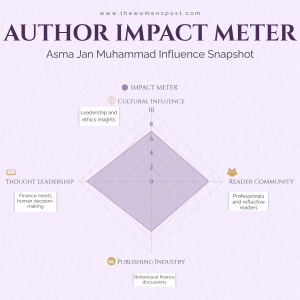
Leadership Insight Contribution
Asma Jan Muhammad’s writing offers a rare inside view of leadership decisions from the perspective of a senior finance professional. Her work highlights the practical dilemmas leaders face when balancing ambition, responsibility, and integrity.
Behavioural Finance Perspective
Through works such as Smart But Wrong, she brings behavioural finance concepts into accessible discussion, helping readers understand how bias, pressure, and organisational dynamics influence decision-making.
Corporate Experience in Storytelling
Drawing from more than two decades in global organisations, her writing introduces authentic corporate dilemmas into narrative form. This allows readers to connect leadership theory with lived professional experience.
Ethics in Ambition
A central theme across her work is the relationship between ambition and values. Her writing encourages professionals to pursue achievement while remaining aware of the ethical consequences of leadership decisions.
The Women’s Post Author Insight
At The Women’s Post, we believe women authors bring perspectives shaped by experience, resilience, and reflection. Their work often explores leadership and personal growth through deeply human stories.
Through her writing, Asma Jan Muhammad contributes to this evolving conversation. Her work highlights the emotional realities behind professional success and encourages readers to examine ambition with greater awareness and integrity.
Key Takeaways from Asma Jan Muhammad’s Journey
- Leadership decisions often involve emotional and ethical dimensions beyond numbers and strategy.
• Behavioural finance helps explain why intelligent decisions sometimes fail.
• Awareness and reflection play an essential role in balancing ambition with integrity.
• Sustainable success depends not only on achievement but also on the values preserved along the way.
• Thoughtful leadership requires the courage to pause, reflect, and examine decisions carefully.
What’s Next for Asma Jan Muhammad?

Asma’s current focus centres on continuing the conversation around her recent book Smart But Wrong.
The book explores how cognitive bias and organisational dynamics influence decision-making in leadership and finance.
Alongside the book, she is expanding the conversation through articles, speaking engagements, and professional dialogue. These discussions aim to encourage more thoughtful and sustainable approaches to leadership.
Looking ahead, she plans to continue exploring behavioural finance, leadership responsibility, and ethical decision-making through both writing and public conversations.
Conclusion
Asma Jan Muhammad’s work bridges corporate leadership and reflective storytelling. Drawing from more than two decades of professional experience, she explores the ethical and emotional dimensions that often shape leadership decisions.
Her writing invites readers to examine ambition, responsibility, and success with greater awareness. In a professional world that often measures achievement through outcomes alone, her perspective reminds us that the values preserved along the journey may matter just as much as the results achieved.
Connect with and learn more about Asma Jan Muhammad on LinkedIn & Instagram.
Also Read:
Economic Implications Of Advancement Of Women In The Technology Sector