




Perimenopause Symptoms In Women No One Talks About (And What To Do)

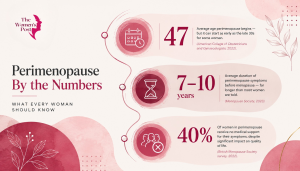
There is a version of perimenopause that most women have heard of: hot flashes, periods stopping, menopause. And then there is the version that actually happens — the one that begins years earlier, looks nothing like what you expected, and gets misdiagnosed as anxiety, depression, or burnout. Research published in Menopause: The Journal of the Menopause Society found that the average perimenopause symptoms in women occur for 7 to 10 years before reaching menopause — yet most receive no information about what is happening until symptoms become severe. This guide is for the years before that point.
First: What is Perimenopause, and When Does it Start?
Perimenopause is the hormonal transition that precedes menopause — defined as 12 consecutive months without a period. But perimenopause itself is a process, not a moment, and it can span 2 to 12 years.
The defining feature of perimenopause is not a steady estrogen decline — it is erratic hormonal fluctuations. Estrogen can surge unpredictably and then crash. Progesterone drop typically happens earlier in the transition. This unpredictability is what makes perimenopause so hard to recognise and so disorienting to live through.
11 Perimenopause Symptoms Women Most Commonly Miss
These are structured roughly in order of how frequently they are overlooked — starting with the ones most often misattributed to something else entirely.
-
Anxiety that arrives without an obvious cause
Perimenopause and anxiety are far more closely linked than most women — or their GPs — know. Estrogen directly regulates serotonin and GABA, the neurotransmitters that keep anxiety in check. When estrogen begins fluctuating, those systems destabilise.
What makes this particularly difficult is that the anxiety often does not feel like a response to anything specific. It arrives at rest, in the middle of ordinary moments, or as a low-level background dread. It is frequently diagnosed as generalised anxiety disorder and treated with antidepressants rather than investigated for hormonal cause.
-
Perimenopause brain fog
Perimenopause brain fog is one of the most distressing and least discussed symptoms. Estrogen supports blood flow to the brain, aids neurotransmitter production, and plays a direct role in memory consolidation. When it fluctuates erratically, cognitive function suffers.
This shows up as forgetting words mid-sentence, losing track of what you were doing, or feeling mentally slower than your baseline. A study in Menopause (2019) found that verbal memory and processing speed were measurably impaired during perimenopause — and improved after the menopause transition was complete. It is not early dementia. But it is real, and it deserves to be named.
-
Sleep that changes in quality, not just quantity
Perimenopause sleep problems go beyond being woken by night sweats. Many women find their sleep architecture changes — they wake more easily, spend less time in deep sleep, and feel unrefreshed even after a full night in bed. Progesterone drop is a major driver: progesterone has a direct sedative effect on the nervous system.
A longitudinal study from the Study of Women’s Health Across the Nation (SWAN) found that sleep disturbances increased significantly during perimenopause and were strongly associated with both estrogen fluctuation and progesterone decline — independent of hot flashes.
-
Rage and irritability — not just sadness
Perimenopause mood changes are not just weepiness or low mood. Many women describe emotional volatility that feels foreign — rage that flares disproportionately, irritability that settles like a weather system.
These changes are driven by estrogen’s role in modulating the brain’s emotional processing centres. The SWAN study found that perimenopausal women were significantly more likely to report high depressive symptoms, irritability, and mood instability than premenopausal women — even controlling for life stress.
-
Weight gain concentrated in the abdomen
Perimenopause weight gain is common and genuinely frustrating because it defies ordinary logic. Estrogen decline shifts fat distribution from the hips and thighs toward the abdomen, and also affects cortisol and insulin sensitivity.
Research published in the American Journal of Epidemiology found that perimenopausal women gained an average of 1.5kg per year during the transition — and that standard dietary advice alone was insufficient to prevent it.
-
Heart palpitations
Sudden awareness of the heartbeat — racing, fluttering, or pounding — prompts many women to seek urgent cardiac evaluation. Heart palpitations during perimenopause are usually caused by estrogen decline affecting autonomic nervous system regulation, not cardiac disease.
Always rule out cardiac causes first. In the absence of underlying heart disease, perimenopause-related palpitations are generally benign and respond well to hormonal management.
-
Joint pain and muscle stiffness
Estrogen has anti-inflammatory properties, and its decline can trigger joint pain, stiffness, and muscle aches that many women attribute to ageing or overexertion.
A survey by the British Menopause Society found that joint pain was reported by 47% of perimenopausal women but recognised as a hormonal symptom by fewer than 20% of those women.
-
Changes in bladder function
Estrogen maintains the tissues of the urinary tract, and its decline leads to bladder urgency, increased UTI frequency, and vaginal dryness — sometimes called Genitourinary Syndrome of Menopause (GSM). These can begin in perimenopause, years before menopause.
These symptoms are very treatable — often with localised vaginal estrogen therapy. Yet fewer than 25% of women with GSM discuss it with their doctor, according to a survey in Menopause International.
-
Changes in periods before they stop
Irregular periods in perimenopause do not follow a simple gradual fade. For many women, periods initially become heavier, longer, and closer together before eventually becoming less frequent.
Tracking cycle changes is one of the most useful things a woman in her 40s can do. Changes in cycle length of more than 7 days are considered a clinical marker of perimenopause onset.
-
Skin, hair, and sensory changes
Estrogen maintains moisture and collagen in skin and hair. As it declines, women may notice dry skin, hair shedding, heightened sensitivity, and occasionally a crawling sensation under the skin known as formication.
Formication is almost never mentioned in standard symptom lists, yet it is a recognised symptom with a clear hormonal mechanism.
-
Loss of confidence and identity
Many women in perimenopause describe a loss of confidence that is qualitatively different from ordinary self-doubt — a sense of not quite recognising themselves.
This is partly neurological — estrogen affects dopamine systems involved in reward and self-perception. It is not a psychological weakness. It is a symptom with a cause.
Expert Interview
Dr. Louise Newson on the perimenopause symptoms that get missed most often
Dr. Louise Newson is a GP, menopause specialist, and founder of the Newson Health Menopause & Wellbeing Centre, and author of Preparing for the Perimenopause and Menopause.
Q: What is the most common mistake you see when women present with perimenopause symptoms?
A: Not connecting the symptoms to hormones at all. Women come in with anxiety, poor sleep, joint pain, and brain fog, and get referred to psychiatrists or rheumatologists. When these symptoms cluster in a woman in her 40s and come and go with her cycle, the first question should be hormonal. We are missing it systematically.
Q: Why do so many women go undiagnosed for years?
A: Perimenopause symptoms are varied and non-specific. Blood tests are unreliable because hormones fluctuate so dramatically that a single test can look normal in a very symptomatic woman. And there is a real knowledge gap — many GPs receive fewer than two hours of menopause education in their entire training.
Q: What do you wish more women knew about perimenopause treatment options?
A: That they exist, and they work. Hormone replacement therapy — particularly body-identical hormones — is safe for the vast majority of women and highly effective. The fear around HRT for perimenopause was largely built on a misinterpreted 2002 study using older synthetic formulations. The evidence has moved on significantly.
Q: Any advice for a woman who suspects she is in perimenopause but has been dismissed by her doctor?
A: Keep a detailed symptom diary noting timing, severity, and cyclical patterns — this is clinical evidence. Seek a second opinion, ideally from a doctor with menopause training. And know that your symptoms are real, hormonal, and treatable. You do not have to push through alone.
What to do About Perimenopause Symptoms: A Practical Summary
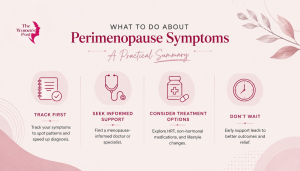
Track first
Start a symptom diary today. Note when symptoms occur, their severity, and whether they track with your cycle. This dramatically accelerates diagnosis.
Seek informed medical support
Not every GP is well-trained in perimenopause. If dismissed, request a referral to a menopause specialist. Dedicated menopause clinics now exist in many countries specifically for this.
Consider perimenopause treatment options
Hormone replacement therapy for perimenopause is the most evidence-based treatment for moderate-to-severe symptoms. Non-hormonal options — SSRIs, gabapentin, fezolinetant — help with hot flashes and mood. Lifestyle changes support all of the above.
Do not wait until it becomes a crisis
Early intervention is significantly more effective than managing a prolonged symptomatic period. If two or three symptoms above resonate, that is sufficient reason to seek a conversation with a healthcare provider.
This article is for general informational purposes and does not constitute medical advice. Statistics cited are from published peer-reviewed sources and professional society surveys. Please consult a qualified healthcare professional for personalised guidance.