
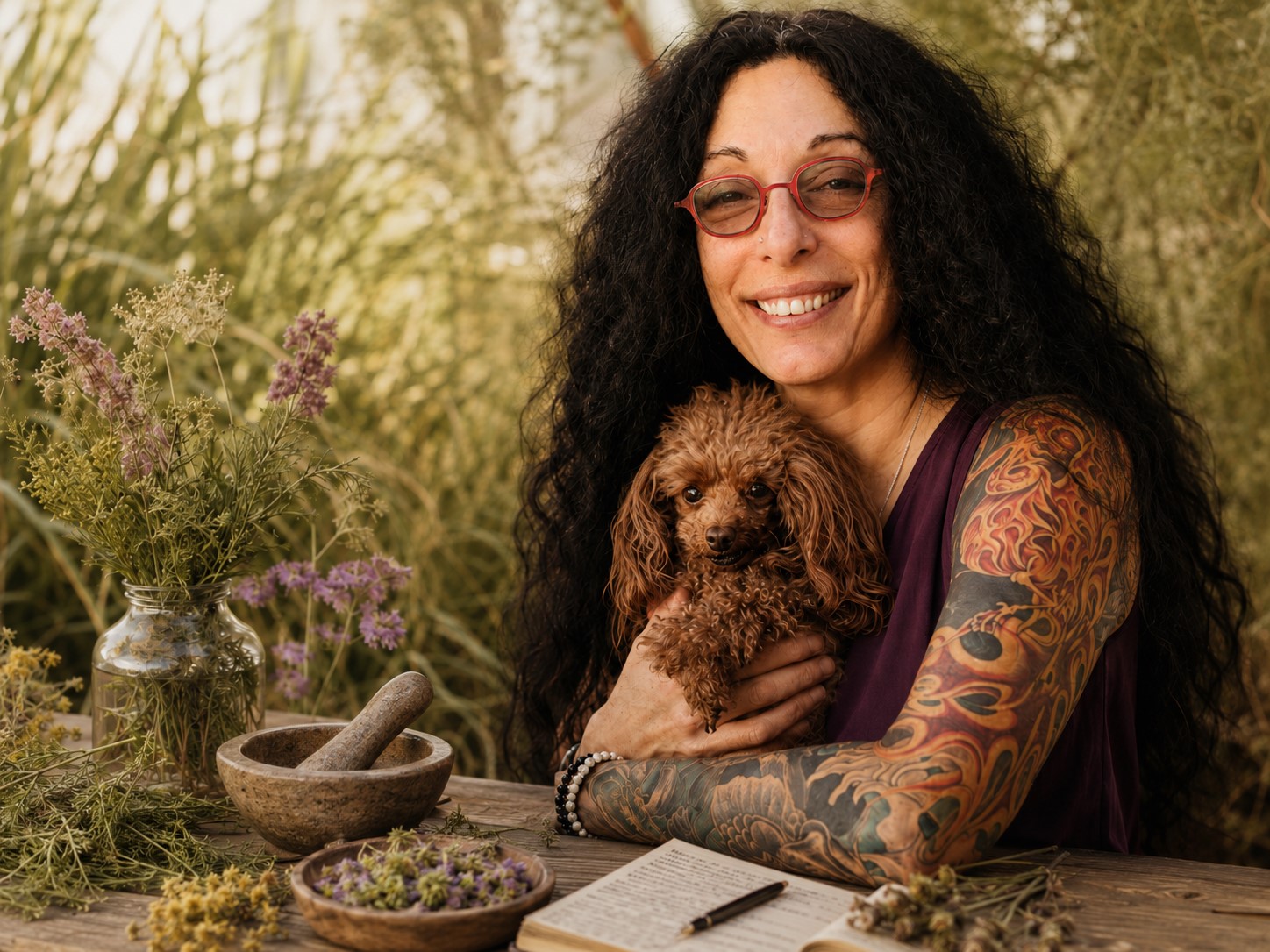



Virginia Joy Musacchio Explores The Power of Intuition in Healing
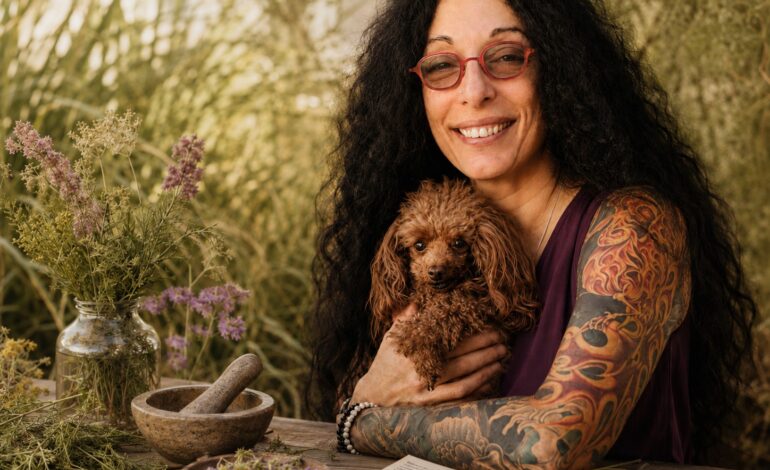

Aromatherapist Virginia Joy Musacchio explores intuition, body awareness, energetic practice, and the relationship between self-trust and evidence.
The evening walk was supposed to last fifteen minutes. Virginia Joy Musacchio had already injured one knee exercising, then managed to trip and scrape the other. Now her knee was hurting, and the original plan wasn’t looking particularly appealing.
“Apparently embodiment was going extremely well,” she says.
So she walked a little farther, turned around, and headed home. No extraordinary spiritual revelation. Just a woman paying attention to her body and changing what she was doing.
“I had a plan, my body gave me some information, and the plan changed.”
For Musacchio, founder of Stillpoint Aromatics and The School at Stillpoint, that ordinary moment captures something essential about intuition and healing. Inner signals deserve attention. Understanding what they’re telling us is another matter entirely.
Investigating Intuition For Healing
Musacchio spent eight years studying energy medicine and clairvoyance with her teacher and mentor, Sharon. One of the things she learned was knowingness, a term Sharon used for receiving information without necessarily seeing an image or consciously reasoning through every step.
But years of studying intuition have also made Musacchio interested in how easily people can mistake the way information arrives for evidence that it must be true.
“Even intuition can acquire a dress code,” she says.
In some spiritual circles, a dramatic vision carries more authority than a quiet impression. A person who sees colors may seem more spiritually gifted than someone who simply knows something without understanding how it arrived.
Musacchio questions that hierarchy. “Delivery is not accuracy.”
A feeling can be entirely real as an experience while the explanation we give it is mistaken. Fear, expectation, past experiences, and the circumstances of the moment can all influence what we think an inner signal means.
The useful question becomes: What am I actually noticing, and what have I already decided it means?
Self-Trust Begins With Listening to the Body
“The body gets a vote,” Musacchio says. “A vote is not a throne.”
Her sore knee gave her information about her knee. It didn’t become an oracle because it hurt.
She knows how easy it can be to sit through meditation while ignoring exhaustion, to keep going when the body is asking for rest, or to treat an ordinary physical need as an interruption to something supposedly more spiritual.
For Musacchio, stillness doesn’t require an elaborate ritual or a perfectly arranged meditation space. Sometimes it means allowing enough quiet to notice what is happening before trying to explain, correct, or transform it.
And sometimes listening to the body means doing something practical: eating, resting, changing a plan, or asking for help.
Virginia Joy Musacchio on Choosing Wellness Practices
During an aromatherapy consultation for someone with a muscular injury, Musacchio considered Plai (Zingiber cassumunar), an aromatic plant traditionally used in Thai medicine. Its history of use and chemical composition made it a reasonable oil to consider for the blend.
“On paper, Plai belonged in that blend,” she says.
But before finalizing the formulation, she used a pendulum, one of the energetic tools in her personal practice, to assess resonance with the person receiving it.
Not a match.
She left it out.
The chemistry hadn’t changed. Neither had the information that made Plai worth considering. Musacchio explains the distinction in her own words:
“I was not using the pendulum to diagnose the injury or replace chemistry, safety, training, or what the person had told me. I was asking a different question: Does this medicine belong with this person?”
“The pendulum did not become God,” she adds.
Musacchio teaches essential-oil chemistry, reads GC/MS reports, and works energetically. She takes each seriously without asking one to establish what belongs to another.
“I don’t need mystery to make facts stupid, and I don’t need facts to make mystery embarrassing.”
Her position on medical care is equally clear.
“I would not ask an X-ray to locate my soul body, and I would not ask a chakra chart to diagnose my knee. I can work energetically and still call a doctor.”
For those choosing wellness practices, she encourages curiosity about both personal experience and what can actually be established. What does the practice involve? What does the research support? What are its limitations and risks? What does the person notice in their own experience?
Three Ways to Strengthen Intuitive Awareness
For Musacchio, learning to trust intuition happens in ordinary life, including the moments when the mind is absolutely convinced it has figured out why something feels wrong.
- Notice the feeling before appointing a culprit. An uneasy feeling doesn’t automatically mean the unanswered email is bad news. Musacchio knows how quickly the mind can take a sensation and build an entire explanation around it. The feeling deserves attention. The explanation deserves investigation. They aren’t necessarily the same thing.
- Listen to the body you actually have. If your knee hurts, change the walk. If you’re hungry, eat. If you’re exhausted, perhaps the answer isn’t another meditation or energetic practice. Sometimes the most useful response to an inner signal is ordinary. The body doesn’t have to deliver a profound spiritual message before you pay attention to it.
- Trust your nose, and do your homework. An essential oil may smell beautiful to you. That’s a real experience, and it matters. But enjoying a scent doesn’t tell you everything about the plant, its chemistry, or how to use it safely. Learn the botanical name. Read the documentation. Ask questions. And when you’re dealing with a health concern, involve an appropriately qualified medical professional.
That balance leaves room for something Musacchio cares deeply about: pleasure without having to justify it as treatment.
“A smell can make a room feel welcoming before I have thought a single impressive thought,” she says.
“Sometimes I like how something smells. That is already an experience.”
Virginia Joy Musacchio’s Vision for the Future
“I want people to need me less,” Musacchio says.
She would like to see a wellness community where people develop their own understanding rather than continually searching for someone else to provide certainty.
That means making room for questions, acknowledging what evidence can establish, and taking personal experience seriously without assuming every impression is infallible.
She is exploring these ideas in her book-in-progress, The Honest Unknown, about trust, authority, and what happens when we stop pretending to know more than we do.
“I go as far as I can honestly go, and when I reach the part I do not know, I stop pretending I do.”
Connect with Virginia Joy Musacchio on LinkedIn, explore botanical offerings at Stillpoint Aromatics (https://www.stillpointaromatics.com), and discover her classes and educational programs at The School at Stillpoint (https://theschoolatstillpoint.com).
Also Read:
Female Founders Who Raised VC Funding in India: Lessons and Insights