



PCOS in Indian Women: Causes, Symptoms & What Actually Works

A data-backed, India-specific guide to understanding and managing PCOS — with real statistics, expert insight, and approaches that fit real Indian lives.
One in five Indian women has it. Most have no idea.
PCOS in Indian women is not an edge case; it is one of the most prevalent chronic health issues affecting women of reproductive age in India today. And yet it remains profoundly underdiagnosed, frequently mismanaged, and rarely discussed openly.
This guide covers what PCOS actually is, why Indian women are disproportionately affected, what the symptoms look like in practice, and, most importantly, what the evidence says actually works.
The scale of the problem: what the data says
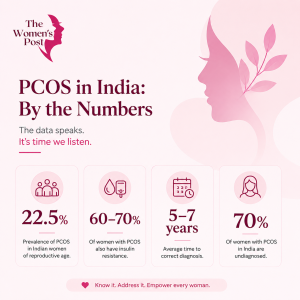
Before getting into causes and solutions, the numbers are worth understanding — because they are striking.
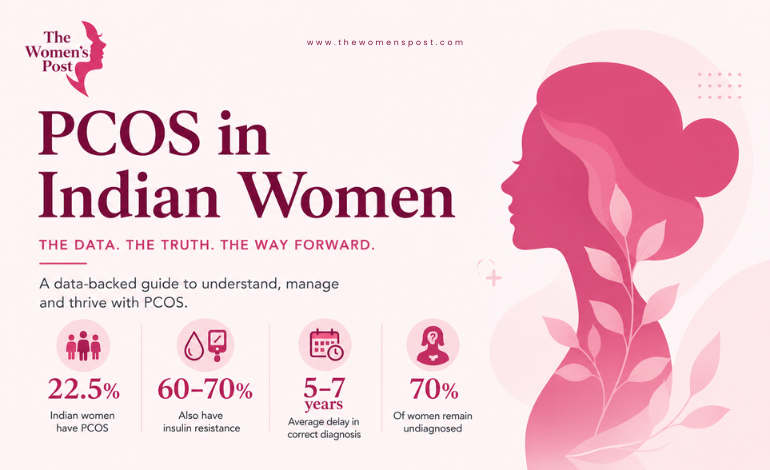
22.5% – Prevalence of PCOS in Indian women of reproductive age, per a multi-centre study in the Journal of Human Reproductive Sciences (2022) — nearly double the global average of 9–13%.
60–70% – Proportion of Indian women with PCOS who also have insulin resistance — higher than the global average of ~50%, driven by South Asian genetic predisposition to metabolic dysfunction.
5–7 years – Average time between first symptoms and correct PCOS diagnosis in India, per the Indian Fertility Society — meaning most women spend years managing symptoms without knowing why.
70% – Of women with PCOS in India are estimated to be undiagnosed, per the Indian Council of Medical Research (ICMR).
“PCOS in Indian women presents differently from Western populations. We see a higher rate of insulin resistance, more severe metabolic complications, and unfortunately a much longer diagnostic delay. The combination of dietary patterns, genetic predisposition, and low awareness creates a perfect storm.” — Dr. Duru Shah, Gynaecologist and Director, Gynaecworld, Mumbai; Past President, FOGSI
What exactly is PCOS?
Polycystic ovary syndrome is a hormonal condition in which the ovaries produce excess androgens — male-type hormones — that interfere with normal ovulation. The name is misleading: not everyone with PCOS has visible cysts, and having follicles on an ultrasound does not automatically confirm the diagnosis.
At its core, PCOS is a disorder of hormonal signalling. Eggs do not mature and release normally, the menstrual cycle becomes irregular, and the downstream effects ripple through metabolism, skin, hair, mood, and fertility. What makes PCOS in Indian women particularly complex is the near-universal overlap with insulin resistance — a metabolic dysfunction already more common in South Asian populations.
Why PCOS is especially prevalent in Indian women
Genetic predisposition to insulin resistance
South Asian women carry a higher genetic tendency toward insulin resistance than women of European descent — even at lower body weights. A study in the Lancet Diabetes & Endocrinology found that South Asian women develop metabolic complications at BMIs significantly lower than Western thresholds. Since insulin resistance is a primary driver of androgen excess in PCOS, this raises baseline risk substantially.
“What we must understand is that a ‘normal weight’ Indian woman with PCOS may have significant insulin resistance that a standard BMI assessment completely misses. We need to test for it — not assume it away.” — Dr. Anuja Dokras, Professor of Obstetrics and Gynaecology, University of Pennsylvania; Advisor, PCOS Society of India
Dietary patterns and blood sugar
The traditional Indian diet — while nutritious in many ways — is heavily carbohydrate-dominant: white rice at most meals, maida-based breads, sweetened chai multiple times daily, frequent sugary snacks. For women with underlying insulin resistance, these patterns create repeated blood sugar spikes that drive insulin production, which drives androgen excess and menstrual irregularity.
Research published in Nutrients (2021) found that women with PCOS who adopted a low-glycaemic diet showed a 30% improvement in insulin sensitivity and a 22% reduction in testosterone levels over 12 weeks — without any medication change.
Urbanisation and sedentary lifestyles
India’s rapid urbanisation has brought longer working hours, desk-based jobs, reduced physical activity, and significantly higher chronic stress. A 2023 study from AIIMS Delhi found that urban Indian women with PCOS had significantly worse metabolic profiles than their rural counterparts with the same diagnosis — pointing clearly to lifestyle as a major modifying factor.
Delayed diagnosis and normalised symptoms
In India, irregular periods are routinely normalised — told to young women that cycles will settle, or attributed to stress or exams. Weight gain gets blamed on food alone. Skin breakouts are treated cosmetically. This means women arrive at a correct pcos diagnosis an average of five to seven years after symptoms begin.
PCOS symptoms in women: the complete picture
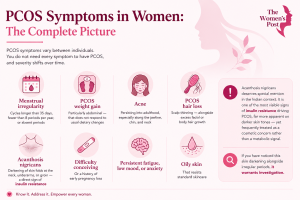
PCOS symptoms in women vary significantly between individuals. You do not need every symptom to have PCOS, and severity shifts over time. The most common signs include:
- Menstrual irregularity — cycles longer than 35 days, fewer than 8 periods per year, or absent periods
- PCOS weight gain — particularly abdominal — that does not respond to usual dietary changes
- Acne persisting into adulthood, especially along the jawline, chin, and neck
- PCOS hair loss — scalp thinning — alongside excess facial or body hair growth
- Acanthosis nigricans — darkening of skin folds at the neck, underarms, or groin — a direct sign of insulin resistance
- Difficulty conceiving or a history of early pregnancy loss
- Persistent fatigue, low mood, or anxiety
- Oily skin that resists standard skincare
Acanthosis nigricans deserves special mention in the Indian context. It is one of the most visible signs of insulin resistance driving PCOS, far more apparent on darker skin tones — yet frequently treated as a cosmetic concern rather than a metabolic signal. If you have noticed this skin darkening alongside irregular periods, it warrants investigation.
How PCOS is diagnosed in India
PCOS diagnosis in India follows the Rotterdam criteria, requiring at least two of three features:
- Irregular or absent ovulation — usually reflected in irregular or absent periods
- Clinical or biochemical androgen excess — acne, hirsutism, or elevated testosterone on blood test
- Polycystic ovaries on ultrasound — 12 or more follicles in one or both ovaries
The challenge is that diagnosis in many Indian clinics stops at the ultrasound. A thorough workup should include: LH and FSH, total and free testosterone, prolactin, thyroid function, fasting insulin, fasting glucose, and HbA1c. Without these, insulin resistance — the most important treatment target — may go entirely undetected.
“An ultrasound alone is not a PCOS diagnosis. I see patients every week who have been told they have PCOS based on follicle counts without a single hormonal test. And I see others told they don’t have it because their ultrasound was normal — when their blood work tells a completely different story.” — Dr. Mala Srivastava, Senior Consultant Endocrinologist, Fortis Hospital, New Delhi
PCOS treatment in India: what the evidence supports
1. Diet: the highest-impact intervention
For PCOS in Indian women with insulin resistance, dietary change is foundational. A PCOS diet in India does not mean abandoning Indian food — it means adapting it:
- Replace white rice with brown rice, red rice, or millets — jowar, bajra, ragi — which have significantly lower glycaemic indices
- Replace maida-based breads with whole wheat or multigrain rotis
- Add protein to every meal — dal, paneer, eggs, Greek yoghurt, chicken — to blunt blood sugar spikes
- Swap sweetened chai for green tea, spearmint tea (with modest anti-androgen evidence), or jeera water
- Eat at consistent intervals — skipping meals worsens insulin resistance, common in busy working women
- Include healthy fats — ghee in moderation, nuts, coconut — which slow glucose absorption
A 2022 clinical trial in the Indian Journal of Endocrinology found that Indian women with PCOS who followed a low-GI Indian diet showed significant improvements in menstrual regularity, testosterone levels, and fasting insulin within 16 weeks.
2. Exercise: consistency over intensity
150 minutes of moderate exercise weekly — brisk walking, yoga, swimming, cycling — significantly improves insulin sensitivity and reduces androgen levels. Strength training is particularly effective for PCOS weight gain and metabolic health. Post-meal walking for 10 to 15 minutes is a traditional Indian practice that is genuinely evidence-based — it measurably reduces blood sugar spikes that feed the insulin-androgen cycle.
3. Metformin for PCOS
Metformin for PCOS is often first-line for Indian women with confirmed insulin resistance. It reduces insulin levels, can restore ovulation, and is inexpensive and widely available across India. A meta-analysis of 29 trials published in Human Reproduction found metformin significantly improved menstrual regularity and reduced androgen levels — with stronger effects in women with documented insulin resistance, the majority of Indian patients.
4. Hormonal treatment
Combined oral contraceptives regulate cycles and reduce androgen-driven symptoms like acne and hirsutism. Anti-androgens like spironolactone address significant hair and skin concerns. These are effective for symptom management but do not address the underlying insulin resistance — which is why they work best alongside lifestyle change.
5. Ayurvedic treatment for PCOS
Ayurvedic treatment for PCOS is widely sought in India. The evidence is preliminary but not dismissible: ashwagandha has shown cortisol-lowering effects relevant to stress-driven hormonal disruption; spearmint tea has demonstrated mild anti-androgen properties in small studies; shatavari is under active investigation. These work best as evidence-informed complements to conventional treatment — not replacements for addressing insulin resistance directly.
PCOS and fertility: what Indian women need to know
PCOS is the leading cause of anovulatory infertility in India, accounting for approximately 70–80% of cases per the Indian Society for Assisted Reproduction. The actual picture is considerably more hopeful than this sounds.
The majority of women with PCOS who want to conceive will do so — often with straightforward interventions. First-line treatment is lifestyle modification and metformin, which restores ovulation in many women without further steps. When medication is needed, clomiphene or letrozole are effective and widely available. IVF is rarely the first step.
“PCOS is the most treatable cause of infertility we have. Most of my patients with PCOS go on to have healthy pregnancies. The key is early diagnosis, addressing insulin resistance, and not catastrophising the diagnosis. A PCOS diagnosis is not an infertility sentence.” — Dr. Firuza Parikh, Director, Department of Assisted Reproduction and Genetics, Jaslok Hospital, Mumbai
Also Read: Why Women’s Hormones Affect Everything: A Complete Guide to Women’s Hormonal Health
Frequently asked questions about PCOS in Indian women
Is PCOS more common in India than in other countries?
Yes. Studies consistently find higher PCOS prevalence in Indian women — estimates range from 9.13% to 22.5% depending on diagnostic criteria and population studied. The combination of genetic predisposition to insulin resistance, carbohydrate-heavy diets, and increasingly sedentary urban lifestyles creates conditions in which PCOS is both more likely to develop and harder to manage.
I am slim. Can I still have PCOS?
Absolutely. Lean PCOS is particularly common in Indian women due to the South Asian tendency toward ‘normal weight metabolic obesity’ — normal weight on the scale but high body fat percentage and significant insulin resistance. Do not assume PCOS is ruled out because your weight appears healthy.
Can PCOS be cured permanently?
PCOS is a long-term condition without a permanent cure, but its symptoms can be very effectively managed. Many women find that regular cycles resume and symptoms ease considerably once insulin resistance is addressed. It does not have to define your daily life.
My doctor only did an ultrasound. Is that enough for a PCOS diagnosis?
No. An ultrasound is one of three diagnostic criteria. A proper evaluation should include hormonal blood tests (LH, FSH, testosterone, prolactin, thyroid) and metabolic tests (fasting insulin, fasting glucose). Without these, the most important treatment target — insulin resistance — may be completely missed.
Does PCOS go away after pregnancy?
Not permanently. Pregnancy does not resolve the underlying hormonal and metabolic pattern of PCOS. Some women find certain symptoms improve after pregnancy, particularly if lifestyle changes made during pregnancy are maintained. The underlying predisposition remains, and symptoms can return if insulin resistance is not actively managed.