





Female Founders Who Raised VC Funding in India: Lessons and Insights

A few years ago, raising venture capital in India meant walking into a room where almost everyone looked the same. The founders were mostly men. The investors were mostly men. And the questions being asked across the table were shaped almost entirely by that dynamic. That picture is shifting, but it hasn’t shifted fast enough.
Female founders raising VC funding in India still receive a fraction of what their male counterparts do. Research on the Indian startup ecosystem consistently shows that women-led startups in India attract less than 10% of total venture capital deployed, even though women entrepreneurs in India are launching businesses at a faster rate than at any point in the country’s history. The gap isn’t about the quality of the businesses. It’s about access, networks, and a funding culture that is still catching up to reality.
But some founders have broken through, and their stories carry real lessons for anyone navigating this landscape today. Here’s a close look at the female founders who raised VC funding in India, what they did differently, and what any woman raising capital in India can take from their journeys.
The State of Female founders Raising VC funding in India: What the Numbers Actually Show
Before diving into individual stories, it helps to understand the broader context of venture capital for women in India.
According to data tracked across multiple funding cycles, women-led startups in India have historically received between 5% and 9% of total VC investment in any given year, despite women founding or co-founding an increasingly large share of registered startups. The gap is widest at the growth and late stages, where check sizes are larger and investor networks tend to be more insular.
The sectors with the highest representation of female founders raising capital in India include consumer brands, edtech, healthtech, and fintech, though even in these sectors, all-women founding teams remain a small minority of funded companies.
This context matters not to discourage, but because women entrepreneurs in India who understand the landscape walk into pitch rooms better prepared. Knowing the structural dynamics means you can anticipate specific types of resistance and prepare for them, rather than being caught off guard in the moment.
Falguni Nayar: Nykaa and the Case Study That Rewrote the Playbook
No conversation about female founders who raised VC funding in India is complete without Falguni Nayar. She founded Nykaa in 2012 at the age of 50, after a long career in investment banking at Kotak Mahindra Capital. That background shaped everything about how she approached building and funding the business.
When Nayar started pitching to investors, she was competing against a dominant narrative that beauty and personal care couldn’t scale online in India. The conventional wisdom at the time was that consumers needed to touch and smell products before buying, and that the category had low margins and high return rates. Nayar came in with data that challenged each of these assumptions directly.
She pointed to the size of the organized beauty retail market, the fragmentation of existing players, and the growing urban consumer’s willingness to buy aspirational products online. She backed every claim with numbers rather than vision statements. And she had credibility, built over decades in financial services, that made investors take the model seriously even when they were skeptical about the category.
Nykaa raised funding across multiple rounds, built a multi-channel presence across e-commerce and physical retail, and eventually listed on Indian stock exchanges in 2021. Nayar became one of India’s few self-made female billionaires, and Nykaa became the most cited data point in any conversation about Indian women in business and what’s possible when the timing, the model, and the preparation align.
Key data points from the Nykaa journey:
- Founded in 2012 with personal savings before raising institutional capital
- Raised across multiple rounds including from TPG Growth, Steadview Capital, and others
- Went public in November 2021 at a valuation of over Rs 1 lakh crore at listing
- Nayar is widely credited as being one of the few founders to build a profitable e-commerce business at scale in India
The lesson for women raising capital in India is not just about beauty or retail. It’s about coming into every investor conversation with data so clear and so well-organized that the only conversation left to have is about scale.
Richa Kar: How Zivame Got Funded Despite Every Uncomfortable Meeting
Richa Kar’s path to raising VC funding in India for Zivame is one of the most instructive stories in the Indian startup ecosystem, partly because it involves a kind of friction that doesn’t show up in most funding playbooks.
When Kar began pitching Zivame, an online platform for women’s lingerie, she faced resistance that was less about the business model and more about investor discomfort with the category itself. Some meetings ended quickly. Others never quite got off the ground because the room itself wasn’t comfortable with the conversation.
Kar’s response was to reframe completely. Instead of pitching lingerie, she pitched a massively underserved retail category, one where Indian women had historically faced limited sizing options, inadequate physical retail experiences, and almost no organized online alternative. She brought market size data, consumer survey findings, and a clear articulation of why the offline shopping experience was broken for this category specifically.
The reframe worked. Zivame raised multiple rounds of venture capital funding in India and became one of the defining stories of Indian e-commerce’s early growth period. The brand eventually attracted interest from larger strategic investors and became a reference point for other women-led startups in India operating in categories that initially made investors uneasy.
The core lesson here applies well beyond lingerie. If you’re a female founder raising capital in India and you’re sensing that investor resistance is rooted in discomfort rather than logic, the most effective response usually isn’t to push harder on the product. It’s to widen the frame and let the market size do the convincing.
Ghazal Alagh: Mamaearth and the Traction-First Approach to Funding
Ghazal Alagh co-founded Mamaearth in 2016 after a straightforward problem: she couldn’t find safe, toxin-free baby care products in India. That personal frustration became the foundation of a brand that eventually scaled into one of India’s most recognizable direct-to-consumer names.
What made Mamaearth’s funding journey distinctive was the sequencing. Before going after large institutional checks, the company built genuine traction using a digital-first approach that combined social media, influencer partnerships, and community-building. Mamaearth partnered with parent communities online, worked with creators who actually used the products, and built a feedback loop that generated both sales data and real customer voice. By the time they sat across from investors, the business wasn’t an idea seeking validation. It was a company with numbers.
Mamaearth raised funding from Fireside Ventures, Sequoia Capital India, and others across multiple rounds. Under its parent company Honasa Consumer, the brand went public in 2023.
Key data points from the Mamaearth journey:
- Built a loyal base of repeat customers before approaching institutional investors
- Used influencer marketing before it became a standard playbook in Indian D2C
- Raised from Fireside Ventures in early rounds, then Sequoia Capital India
- Honasa Consumer listed on Indian stock exchanges in 2023
For any woman entrepreneur in India thinking about the right moment to raise, Mamaearth’s path is a case for building proof before building a pitch deck. Early traction, even modest traction, shifts the tone of every investor conversation from “could this work?” to “how fast can this grow?” That’s a fundamentally easier conversation to have.
Aditi Gupta: Menstrupedia and Raising Capital for a Taboo Topic
Female founders raising capital in India don’t only operate in consumer retail. Aditi Gupta co-founded Menstrupedia, an educational platform focused on menstrual health, and navigated a funding environment where the topic itself was socially sensitive in ways that went beyond commercial skepticism.
Gupta pitched a business built around menstrual education, comic-based content, and materials for schools across India. In some rooms, the very mention of the topic produced the same kind of awkward silence Richa Kar had encountered. Gupta’s approach was similar in spirit: ground everything in data about the scale of the problem, the lack of existing solutions, and the specific gap her platform was filling.
Menstrupedia attracted grant funding, angel investment, and growing institutional interest as the conversation around women’s health in India shifted. The company’s work has been recognized internationally, and Gupta’s story is one of the cleaner examples of a woman entrepreneur in India who treated social mission and business model not as competing priorities but as two parts of the same pitch.
What These Stories Have in Common: Patterns Worth Paying Attention To
Looking across these journeys, several patterns show up consistently enough to be worth naming.
Named founders and real data beat abstract vision. Every founder covered here came into investor conversations with specific numbers, specific market evidence, and specific proof of either demand or capability. In a pitch environment where female founders raising VC funding in India often start with less inherent credibility than male founders with similar profiles, the best equalizer is a business case that can’t be easily dismissed.
The reframe is a legitimate strategic tool. Both Kar and Gupta ran into category-level resistance. Neither abandoned their idea. Both found a way to restate the opportunity in terms that moved the conversation from discomfort to analysis. This is a skill, not a lucky accident, and it can be practiced and refined before you walk into a room.
Traction before capital is a choice, not a consolation. Several of these founders spent meaningful time building the business before raising significant external capital. In some cases this was by necessity. In others it was strategic. The consistent outcome was a stronger negotiating position when they did raise.
Personal connection to the problem is an asset, not a liability. Nayar understood the beauty consumer. Kar understood the retail experience she was solving. Alagh had lived the problem Mamaearth was built to fix. This proximity to the problem is increasingly something investors in the Indian startup ecosystem recognize as a genuine edge, rather than a soft story to be politely acknowledged and moved past.
Practical Takeaways for Women Raising Capital in India
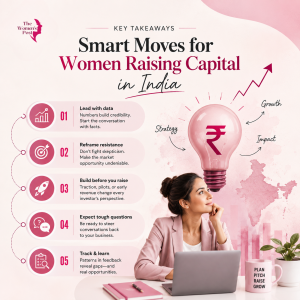
If you’re actively working on a raise or preparing for one, a few things from these case studies are worth internalizing.
Lead with data before you lead with story. The story is important, but investors fund companies, not biographies. If you have traction numbers, customer retention data, or market size research, put them early and let them carry weight.
Reframe category resistance rather than fighting it directly. If a room goes cold at the mention of your product, step back and pitch the market instead. Market size, competitive gaps, and consumer behavior data are harder to dismiss than product enthusiasm.
Build something before raising for it, where possible. Even six months of customer conversations, a small pilot, or early revenue changes the nature of every investor meeting that follows.
Expect some rooms to go off course, and prepare for that specifically. Knowing in advance how you’ll redirect a conversation that drifts toward personal questions rather than business ones keeps you in control without making the room uncomfortable.
Track the feedback across every meeting, not just the outcome. A pattern in what investors keep asking about is usually a signal of either a gap in your business or a gap in your pitch, and both are worth knowing.
Frequently Asked Questions
What percentage of VC funding in India goes to female founders?
Based on data from multiple tracking sources covering the Indian startup ecosystem, women-led startups in India have typically received less than 10% of total venture capital deployed in any given year. All-women founding teams tend to receive an even smaller share. The gap is most pronounced at later funding stages.
Which sectors have seen the most success for female founders raising capital in India?
Consumer brands, direct-to-consumer retail, healthtech, edtech, and fintech have produced some of the most prominent examples of female founders raising VC funding in India. Nykaa in beauty, Mamaearth in personal care, and Zivame in women’s retail are among the most cited cases.
What do investors in the Indian startup ecosystem look for in women-led pitches?
The same things they look for in any pitch: a clear market opportunity, a business model with defensible economics, evidence of traction or demand, and a founding team with the skills to execute. For women entrepreneurs in India, coming in with particularly strong data tends to be especially important for building credibility early in the conversation.
Is it necessary to have a co-founder to raise venture capital in India?
No, though some investors do prefer co-founding teams. What matters more is whether the team, whatever its structure, covers the key capabilities the business needs. Several successful women-led startups in India have had solo founders or husband-and-wife founding teams rather than traditional co-founder arrangements.
How should a female founder handle uncomfortable or off-topic questions in a pitch meeting?
The most effective approach tends to be a firm but calm redirect back to the business. Asking the investor a direct question about their fund’s thesis or portfolio is one way to do this. Coming in with numbers so strong that the conversation is naturally anchored to the business is another. Both approaches protect your time in the room without creating unnecessary friction.
Are there specific programs or networks supporting female founders raising capital in India?
Yes. A growing number of angel networks, accelerators, and VC funds in India have programs or mandates specifically oriented toward women entrepreneurs in India. Government initiatives also exist, though their scale and effectiveness vary. Researching a fund’s existing portfolio for other women-led startups is often the most reliable first filter before reaching out.