






India’s Leadership In Global Female STEM Enrollment

India ranks at the top in terms of female enrollment in STEM fields in the world. Over the past few years, the country has registered a female enrollment rate of 43 percent in science, technology, engineering, and mathematics fields. This rate surpasses the worldwide average, which stands at 35 percent. Although the gap may not be very wide, it represents a clear lead.
India boasts a large number of skilled young women in STEM fields. However, not all young women are able to move to the higher echelons in the field due to obstacles they encounter. This article examines the impressive enrollment rate in STEM fields in India, the reasons for the impressive rate, the opportunities available in the field, the obstacles, and how the country ranks in comparison to other countries.
Impressive Numbers: Female Enrollment in STEM Fields at College Level
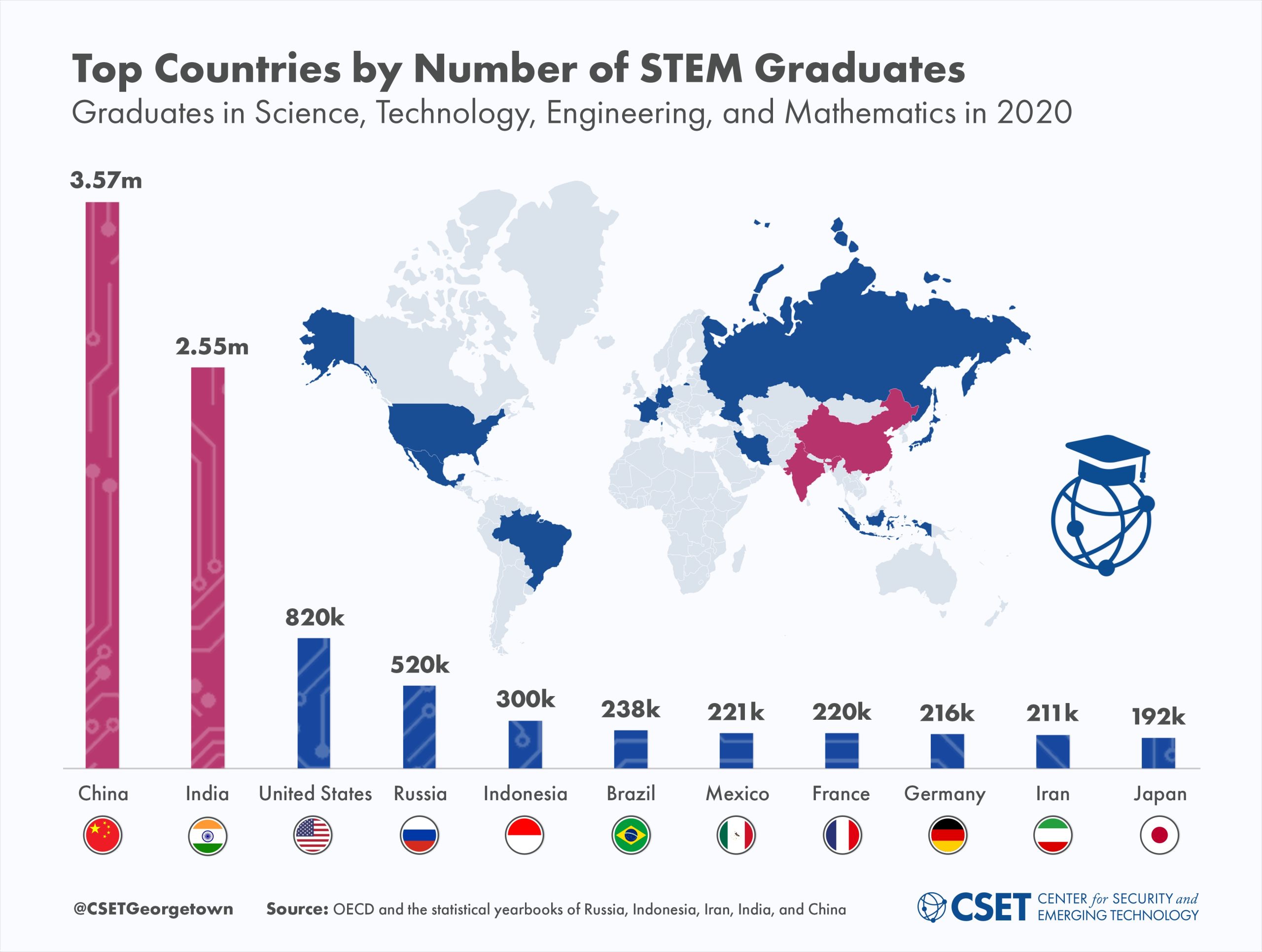
The numbers are impressive in terms of female enrollment in STEM fields at the college level. The rate has been consistently increasing over the past few years. It has risen from an average of 38 percent in the mid-2010s to an impressive 43 percent in the early 2020s. India now turns out nearly 2.5 million STEM graduates each year, and almost half of them are women. This large group forms a ready workforce for the country’s booming technology sector. Global tech firms and Indian IT companies already hire many of these graduates for entry-level jobs in software, data analysis, and engineering. The result is a solid pipeline that helps fill thousands of positions every year. In a world that needs more tech talent, India’s high female participation gives it a real advantage.
Why India Leads in Female STEM Enrollment
Several factors help explain why India leads in this area. Government programs play a big part. Schemes such as Beti Bachao Beti Padhao encourage girls to stay in school and choose science streams. Scholarships, special coaching for competitive exams like JEE and NEET, and reserved seats in top institutes have opened doors. Families in many parts of the country now see engineering and medicine as good, stable careers for daughters.
Also Read: Men’s Role In Advancing Gender Diversity In Tech
Competitive entrance tests treat boys and girls equally, so talent decides entry more than old biases. At the same time, the rapid growth of private colleges and online learning has made STEM courses more accessible, even in smaller towns. These steps have changed mindsets over the last decade. Parents who once pushed girls toward arts or teaching now support them in physics, coding, or biotechnology.
Girls in STEM India have benefited greatly from these changes, making Girls in STEM India a growing success story across the nation. Many initiatives now focus on Girls in STEM India to build confidence from an early age. The progress in Girls in STEM India reflects shifting attitudes toward education and careers. Continued support for Girls in STEM India remains important for sustaining this momentum. Awareness campaigns play a key role in promoting Girls in STEM India. Overall, the rise of Girls in STEM India highlights India’s commitment to inclusive education.
Strong Pipeline for Tech Careers Created by High Enrollment
This enrollment success creates a strong pipeline for tech careers. India’s IT industry is one of the largest in the world and relies heavily on young engineers. Many women join at the start of their careers and perform well in roles like software development, quality testing, and customer support. Companies report that female hires often bring fresh ideas and strong teamwork skills. The pipeline also feeds other sectors, such as pharmaceuticals, renewable energy, and artificial intelligence. With women making up nearly half the new graduates, India can meet future demand without depending only on male talent. In fact, this educated group could add billions to the economy if more of them stay in the field.
The Leaky Pipeline Challenge After Graduation
However, the story changes after graduation. Despite the large number of female STEM students, far fewer women hold actual STEM jobs. Estimates put women at only 20 to 30 percent of the STEM workforce in India. The drop is even sharper at senior levels. In research labs, universities, and top tech firms, women rarely make up more than 15 to 20 percent of professors, scientists, or leaders. This gap is often called the “leaky pipeline.” Women leave or get stuck at different stages for many reasons.

Also Read: Future Outlook: Will AI And New Tech Trends Widen Or Narrow The Gender Gap By 2030?
Some step away after marriage or childbirth because of family duties and lack of support like flexible hours or childcare. Others face workplace bias, where promotions go to men even when skills are equal. Safety concerns in late-night shifts or field work also play a role. In medicine, for example, women form over half of new MBBS students but only about 29 percent of practicing doctors. The same pattern appears in engineering and research. The pipeline that starts so strong in college begins to leak before it reaches the top.
Comparison of Female STEM Enrollment: India vs World and Top Countries
India’s situation stands in contrast to other high-performing regions. In Europe, female STEM enrollment is lower than India’s. The United Kingdom reports about 31 percent women in STEM graduates, Germany around 28 percent, and France near 32 percent. These countries have fewer women starting in the field, but some do better at keeping them in senior jobs through strong policies on parental leave and anti-bias training. The United States shows roughly 34 percent female STEM graduates—still below India—but has more women in certain tech leadership roles thanks to bigger corporate diversity programs.
In parts of Eastern Europe and Central Asia, countries like Romania or Turkey sometimes reach 40 percent female enrollment, close to India’s level. A few nations in the Middle East and North Africa, such as Algeria or Tunisia, have also shown high female participation in science fields because of state-driven education policies. Yet none match India’s absolute numbers or the sheer size of its graduate pool. Globally, the average stays stuck at 35 percent, and the worldwide STEM workforce is only about 28 percent female. India leads in education but shares the same retention problems seen almost everywhere. This makes Why India has highest female enrollment in STEM globally a frequently asked question among educators and policymakers.
Also Read: Conferences, Awards & Global Platforms For Amplifying Women In Tech
When discussing Top countries for female STEM enrollment 2025, India consistently ranks at the top due to its large-scale participation. A clear Comparison of female STEM enrollment India vs world shows India’s 43 percent figure significantly ahead of the global average.
What India Does Well and Areas for Improvement
The comparison highlights what India does well and where it can improve. Other regions with lower enrollment often invest more in mentorship, flexible work, and research funding for women. India could learn from these while building on its own strengths. Some Indian companies have started programs that offer return-to-work support after career breaks or leadership training for women. Government initiatives now focus not just on enrollment but also on retention. Still, real change needs broader efforts—better safety at workplaces, shared family responsibilities, and fair promotion practices.
Future Outlook: Turning Education Leadership into Long-Term Success
Looking ahead, India’s leadership in female STEM enrollment gives it a huge opportunity. If the country closes the gaps in the leaky pipeline, it could unlock massive talent for its tech-driven future. The next decade will test whether these educated women move from classrooms to boardrooms. With the right steps, India can turn its education advantage into lasting leadership in global science and innovation. The foundation is already strong. Now it is time to make sure the pipeline flows all the way to the top.